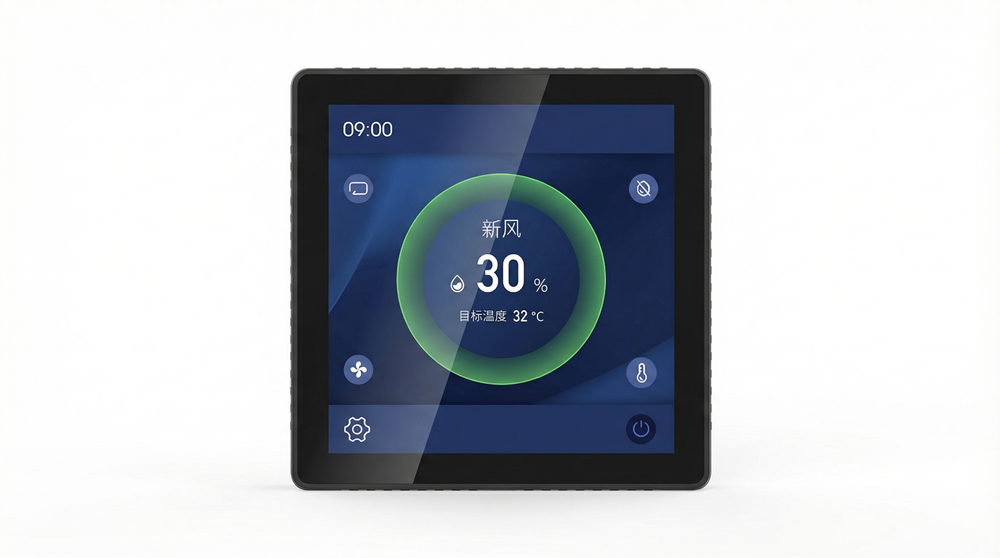
As environmental monitoring requirements continue to rise, air quality products are moving toward multi-parameter sensing and modular integration. Residential buildings, commercial spaces, vehicle cabins, smart homes, fresh air systems, and air purifiers are all driving this shift. The focus is no longer only on individual sensor performance. It is now on whether a full module solution can connect stably and support mass production.
Traditional air quality monitoring often relies on multiple discrete sensors. PM2.5, CO2, TVOC, temperature, and humidity are usually selected, connected, and calibrated separately. This can work in early projects, but the workload increases as products become more complex. Size, wiring, interface adaptation, and algorithm coordination all add extra effort.
Sensor selection is also not easy. Different sensing principles lead to major differences in performance and operating conditions. OEMs must balance accuracy, power consumption, size, lifespan, and cost. Teams without platform experience often spend a lot of time on testing and adjustment.
System connection is another real challenge. After sensors are sourced, work still continues in control, communication, compensation, display, and linkage logic. Components from different suppliers often differ in interface, power requirement, and output logic. These gaps increase integration cost and can slow down mass production.
In this context, multi-in-one air quality modules are becoming a more efficient solution. They bring key sensing functions together on one platform, reduce system complexity, and shorten development time.
What Is a Multi-in-One Air Quality Module System?
A multi-in-one air quality module system integrates several environmental sensing functions into one module. Common parameters include PM2.5, CO2, TVOC, temperature, and humidity. Depending on the application, formaldehyde, odor-related signals, ammonia, or ethylene can also be included.
A mature module is more than several sensors on one board. It includes airflow design, structural design, power management, signal processing, communication interfaces, compensation algorithms, and module-level calibration. Module stability depends on how well these elements work together.
For OEMs and equipment makers, such modules provide a more complete integration platform. They reduce repeated work in both selection and later integration, and improve project efficiency. At MAXMAC, this chain covers product design, module development, interface definition, and calibration systems. Core modules are developed in-house. That also improves system compatibility.

Benefits of Sensor Integration
The first benefit is easier product design. Many end devices have limited internal space. The more compact the module, the clearer the layout becomes. By combining several sensing functions in one structure, the solution fits better in wall controllers, HVAC panels, air purifiers, and automotive systems.
In-house core module development also improves adaptation. Dimensions, power design, and interfaces can be defined early based on the target application. This reduces later changes and makes project control easier.
Integration also lowers system complexity. With discrete sensors, power, communication, and data output often need to be handled separately. A multi-in-one module can offer a unified interface and unified output. This reduces wiring and simplifies software adaptation.
Development time also becomes shorter. Customers do not need to validate sensor combinations from the beginning. They can move directly into sampling and system tuning with a mature module. This is especially valuable in projects with a tight schedule.
In cost terms, a multi-in-one module is closer to system-level optimization. Savings come not only from part count, but also from extra circuits, installation effort, and maintenance complexity. In mass-production projects, this effect can matter more than the unit price of a single sensor.
Another benefit is better overall judgment of air quality. Air quality is not defined by a single parameter. PM2.5, CO2, TVOC, temperature, and humidity are connected. An integrated module makes compensation and linked control easier, and helps produce data closer to real operating conditions.
Production consistency is also easier to build. When several sensing functions are designed, tested, and calibrated on the same platform, quality control can be made more consistent. This directly supports stable mass production.
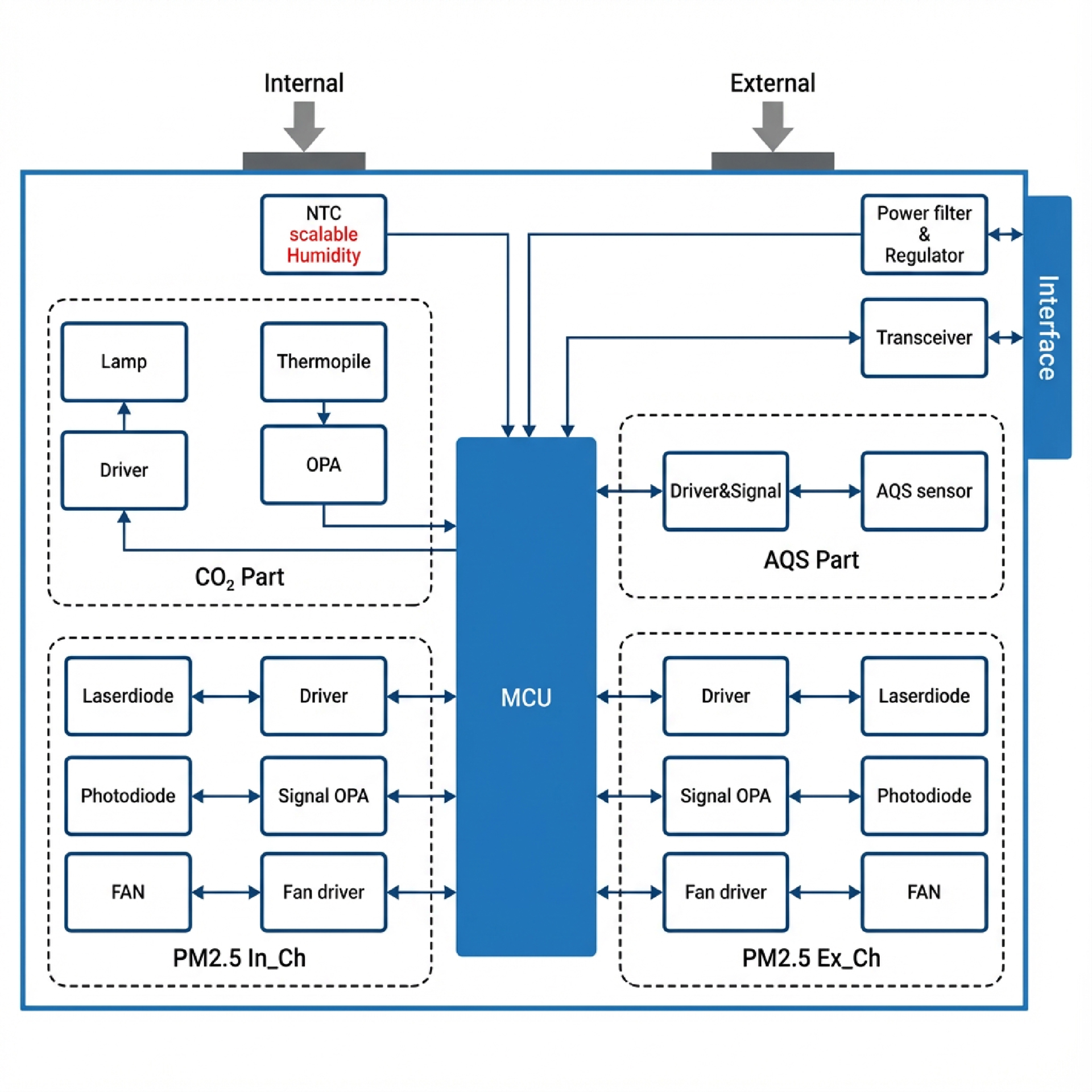
System Design Challenges
Multi-in-one air quality modules improve development efficiency, but they do not reduce technical difficulty. Several sensors must work at the same time in a limited space. This places higher demands on structure, electronics, and algorithms.
One common challenge is sensor interaction. Some components generate heat and can affect nearby temperature and humidity readings. Particle sensors are highly sensitive to airflow. Poor airflow design can also disturb other sensing channels. Power noise and signal interference can further affect the result.
Structural design is equally important. Internal space is often tight. Component position, airflow path, and dust protection must be defined early. If the sampling path is not suitable, the air sample loses representativeness and measurement accuracy drops.
These issues are costly to fix late in a project. For that reason, system design should start early. Teams with experience in product design and module development can plan installation, airflow, and electronics architecture together from the start. MAXMAC follows this early coordination approach in multi-in-one module development.
Electronics design is another key point. Different sensing principles have different requirements for power quality and noise resistance. When several sensors are integrated into one module, EMC, ESD protection, and ripple control must be handled in a structured way. Without this, stable operation in real environments is difficult.
Data processing after measurement is also important. Changes in temperature and humidity affect gas and particle readings. The quality of the compensation logic directly affects the practical value of the module.
Why Calibration Is More Difficult
Calibration is one of the most important parts of multi-in-one air quality module design. Even a single sensor needs stable environmental conditions. In a multi-parameter system, the difficulty becomes higher.
First, each sensor responds differently to environmental change. PM2.5, CO2, TVOC, temperature, and humidity sensors have different sensitivities to temperature, humidity, airflow, and warm-up time. Small fluctuations can affect several channels at once.
Module-related factors also matter. Heat distribution, component spacing, internal space, and airflow path all change the final output. For this reason, component-level calibration is often not enough. A multi-in-one module needs calibration as a complete system.
Joint calibration of several parameters is also complex. There are interactions between measured values. Temperature and humidity compensation, zero-point correction, and drift control need to be handled within one framework. At this stage, calibration becomes a system task rather than a simple process.
For module suppliers, calibration quality directly affects delivery quality. MAXMAC uses a module-level calibration approach. Follow-up calibration logic is considered during core module design, together with a matching calibration system. This helps control interaction between parameters and improves consistency from samples to mass production.
There is also a clear difference between lab calibration and production calibration. Lab work focuses on fine validation. Production focuses on efficiency and repeatability. Fixture consistency, environmental change, and batch differences all affect the result. For that reason, an industrialized calibration structure is essential.
Long-term stability is also part of calibration strategy. Modules operate in end equipment over long periods. Drift, contamination, aging, and environmental influence all change output. In-house modules and in-house calibration systems make continuous optimization and application tuning easier.

Main Application Areas
Multi-in-one air quality modules are widely used in HVAC systems, fresh air systems, air purifiers, smart home terminals, commercial air monitoring devices, wall controllers, and automotive systems.
In residential and commercial spaces, they are used for environmental monitoring and control. In vehicles, they support in-cabin air quality management. In agriculture, pet products, and industrial special applications, multi-parameter modules provide a compact monitoring solution.
Different applications require different design priorities. Whether a supplier has system capability from function definition to equipment integration directly affects implementation speed. MAXMAC’s multi-in-one air quality modules are designed around application needs, with internal coordination across interface, integration, and calibration adaptation.

Conclusion
Multi-in-one air quality module system design has become an important direction in air monitoring. For OEMs and system integrators, it is no longer enough to look only at individual sensor performance. Integration, system design, calibration, and mass-production control are now key decision points.
Sensor integration improves space use, lowers system complexity, and shortens development time. At the same time, selection, system connection, and module-level calibration remain major challenges.
Competitive multi-in-one air quality modules rely on system design, joint calibration, compensation algorithms, and long-term stability. For companies with in-house core module development, coordinated product design, and in-house calibration capability, the module represents more than a product. It represents full system capability.