
The 2026 Beijing Auto Show made one thing clear: competition among Chinese new energy vehicles is now heavily centred on the smart cockpit. Screens, voice interaction, entertainment and seat comfort remain the baseline experience, while green and healthy cabin functions are gaining much more prominence. Automakers are beginning to treat air quality, thermal comfort and odour management as part of one cabin-experience system, with health sensing and emotional comfort becoming visible product features.
Two forces are driving this shift. First, people are spending more time in their vehicles. Beyond daily commuting, family road trips, lunch breaks and camping are turning the cabin into a place to stay, not just a place to sit while moving. Second, automakers' cockpit voice systems and LLM capabilities are maturing. Functions that used to be buried in the climate page or vehicle settings, such as air purification, fresh air, CO₂ monitoring and fragrance, can now be called up naturally through the AI cockpit and combined with seats, lighting and music as complete scenarios.
Display vehicles at the 2026 Beijing Auto Show and new-vehicle configurations released around the same time point in the same direction. Cabin air systems are evolving from standalone purification features into healthy-comfort closed loops that combine sensing, actuation, air improvement, fragrance release and AI scenario orchestration.
This article is based on on-site observations from the 2026 Beijing Auto Show, newly launched vehicle configurations and public information available as of 2026-05-06. The survey covers major Chinese independent brands, emerging EV makers and smart-cockpit ecosystems.
1. Core View: Cabin Air Systems Are Becoming Part of the Cockpit Domain
From a feature-tiering perspective, cabin air systems now show a relatively clear market structure. PM2.5 monitoring and filtration, CN95 filters and activated-carbon composite filters are becoming baseline equipment on new energy vehicles. This layer mainly addresses urban commuting, smog, pollen and basic respiratory-health needs. It answers the first question users ask after entering the vehicle: is the air clean?
In mid- to high-end models, differentiation is moving toward active air management. AQS automatic air-quality control, negative-ion or plasma generators, UV sterilisation and low-odour materials suitable for maternal and infant scenarios are being used to distinguish healthier cabins. The value is not only cleaner air, but also the ability to identify pollution, isolate it and purify the cabin proactively.
In premium models, MPVs, three-row SUVs, RVs and long-stay use cases, CO₂ sensors are becoming a more targeted feature. They are designed for full-passenger road trips, lunch breaks, camping and other situations where people remain in a closed cabin for longer periods. As vehicles take on more "stay-in" use cases, the value of linking CO₂ data with fresh-air strategies will continue to rise.
Fragrance systems are also moving downmarket, from luxury flagships into high-volume new energy models priced around RMB 150,000 to 250,000. Their role is shifting from a simple comfort feature to an "emotional actuator": replaceable cartridges, intensity control and scent selection can be linked with welcome, nap, refresh, meditation and deodorisation scenarios, giving the brand experience a more tangible cabin atmosphere.
| Configuration level | Representative configuration | Main model range | System value |
|---|---|---|---|
| Basic air package | PM2.5 filtration, PM2.5 monitoring, CN95 filters, activated-carbon filters | Mainstream new energy models | Handles particles, pollen, basic odours and urban-commuting filtration needs |
| Active air management | AQS, VOC detection, negative ions, plasma, UV sterilisation, smart fresh air | Mid- to high-end models | Links HVAC recirculation, fresh-air intake and purification based on air quality inside and outside the vehicle |
| Health and scenario cabin | CO₂ monitoring, oxygen monitoring, fragrance system, air visualisation, AI scenario linkage | MPVs, three-row SUVs, flagship models, family vehicles | Supports closed-loop cabin control for road trips, full-passenger travel, lunch breaks, camping and mood-based scenarios |
2. Key Technologies and Future Direction: Sensing, Fragrance and Closed-Loop Control
The foundation of a green and healthy cabin is multi-dimensional environmental sensing. PM2.5 sensors and AQS sensors provide the basic air-quality judgement: the former detects particles, pollen and smoke, while the latter detects pollutant gases such as exhaust, odour, VOCs and NOx. These sensors allow the HVAC system to adjust recirculation and fresh-air intake automatically according to outside pollution, and to increase purification airflow when in-cabin particles rise. Temperature and humidity remain key inputs for thermal comfort and defogging strategies. For OEMs, these sensors are moving from standalone displays to core data sources for HVAC controllers and cockpit domain controllers.
CO₂ sensors deliver the most value in long-stay scenarios. Li Auto, Denza/Yangwang and selected MPVs, three-row SUVs and RV-style models show stronger attention to CO₂ and fresh-air strategies. The reason is simple: closed windows, multiple occupants and long parking breaks can cause CO₂ to build up, leading to sleepiness, dizziness or stuffiness. Once CO₂ data enters HVAC control, the system can balance pollution isolation, fresh-air supply, defogging, heating energy consumption and occupant comfort. In the future, this strategy will move from "display only" to automated control, especially for family road trips, lunch breaks, camping and parked rest periods.
Smart fragrance is another technology track worth watching. Traditional in-car fragrance was closer to "car perfume" and mainly addressed odour and a sense of luxury. Beijing Auto Show observations and configuration materials suggest that fragrance is becoming part of active air management: replaceable cartridges, heated release, scent selection, intensity control and vehicle-side HMI are increasingly common in production models. BYD Group, NIO, Wenjie/Zunjie, Denza/Yangwang, Fangchengbao, Zhiji, high-end Zeekr/Lynk & Co/Galaxy models, Volkswagen ID.ERA 9X and ID. UNYX 08 have already positioned fragrance as a premium comfort feature and are beginning to integrate it into welcome, nap, meditation, refresh and deodorisation scenarios.
The next phase of upgrade will focus on three levels. First, the all-in-one air quality sensor will increase the level of integration, putting PM2.5, CO₂, AQS, and temperature and humidity into a more compact hardware system, reducing layout space and wiring harness complexity. Second, the CO₂ strategy will become an important control variable for smart HVAC systems, especially in finding a balance between heating in winter, internal circulation to isolate pollution, and long-term parking. Third, the fragrance module will change from a comfort configuration to a cockpit domain actuator, which can be called in combination with driving mode, rest mode, weather, time and user preferences. Health status visualization will also continue to be enhanced. The central control screen will display more air quality, CO₂ concentration, purification progress, filter life and fragrance balance, allowing users to see the actions being performed by the system.
| Technical direction | Current mass production performance | Focus on subsequent evolution |
|---|---|---|
| Multi-dimensional environmental sensors | PM2.5, AQS, CO₂, temperature and humidity are connected to air conditioning and vehicle systems respectively | All-in-one integration, improved response speed, unified air quality data model |
| CO₂ strategic management | Focus on family-oriented, high-end and long-stay scenario models | Linked with fresh air ratio, internal and external circulation, defogging and energy consumption control |
| Intelligent fragrance system | Replaceable fragrance cartridges, fragrance selection, concentration adjustment and vehicle HMI have appeared | Fragrance identification, residual monitoring, stable release and cockpit scene linkage |
| Health status visualization | Some models have displayed PM2.5, AQS, CO₂, oxygen content and purification status | Turn the air quality improvement process, consumable status and scene strategies into user-visible information |
3. AI Cockpit: The Interaction and Orchestration Layer of the Green Healthy Cabin
The control entry point for air functions is moving from the climate page and vehicle settings into AI voice, scenario cards and cockpit modes. HarmonyOS Cockpit/Xiaoyi, DiLink/Denza Link/Yangwang Link, XPeng Tianji/AI Xiao P, Li Auto Assistant/Mind GPT, NIO NOMI/NOMI GPT, Xiaomi HyperOS Cockpit/Xiao Ai, Flyme Auto/Hi Eva/AI Galaxy Assistant, ADiGO, Xiaoqi Assistant and Coffee GPT already have the foundations to combine air purification, fresh air, fragrance, seats, lighting, music, navigation, weather and user status into active scenarios.


From a scenario-design perspective, healthy commuting usually starts with PM2.5/AQS monitoring. The system switches between recirculation and fresh air based on pollution outside the vehicle, then shows the current purification status on the air-quality display. Family road trips place more emphasis on CO₂ monitoring, fresh-air supply and low-intensity fragrance to reduce stuffiness during long closed-cabin drives with multiple occupants. Nap, meditation and refresh modes rely more on fragrance, seats, lighting and music, while the air system reduces fan noise, maintains comfortable temperature and humidity and releases the selected scent. Camping and long parking scenarios bring CO₂, fresh air, temperature, humidity and energy management together so occupants can feel safe and comfortable during extended stays. For post-sun-exposure purification and pre-entry deodorisation, remote climate control, high-airflow ventilation, VOC monitoring and fragrance-based deodorisation address stuffiness and odour before the user enters the vehicle.
OEM scenario strategies are also starting to diverge. Huawei HarmonyOS Intelligent Mobility emphasises air-quality visualisation and multi-device collaboration. Models such as the Zhijie V9 bring oxygen level, CO₂, PM2.5, AQS and oxygen generation/purification functions into the cockpit page for family travel, rest and long-stay scenarios. Li Auto is more focused on family users, integrating CO₂, fresh-air HVAC, three-row passenger comfort and Task Master capabilities around full-passenger road trips, lunch breaks, children and elderly passengers. BYD strengthens healthy-cabin and fragrance experiences through Denza and Yangwang, while pushing PM2.5, negative ions and fragrance into higher-volume price bands through Fangchengbao and Dynasty/Ocean. NIO uses NOMI and smart fragrance to reinforce emotional interaction for welcome, rest and fragrance-purification scenarios. Geely, Zeekr, Lynk & Co and Galaxy use Flyme Auto, Hi Eva or AI Galaxy Genie to make air, pet, camping, car-wash and family-road-trip scenarios easier to access. Volkswagen uses VW OS, UNYX.OS, 8295/8295P chips, in-car fragrance, PM2.5 filtration and air purifiers to bring joint-venture air-comfort features into a new-generation cockpit system.
The industrial value of the AI cockpit lies in turning distributed hardware into scenarios users can actually perceive. Once air-system status, air-quality changes, CO₂ ventilation judgement, fragrance release and filter life enter the HMI, air functions move from background control to front-stage experience. For OEMs, competition in green and healthy cabins will increasingly look like competition in scenario product design: the brands that combine sensors, HVAC, fragrance, seats and voice assistants most naturally will turn health features into everyday cockpit experiences.
4. OEM Strategies: Flagship Positioning, Family Scenarios and Mass-Market Adoption
Automakers are taking different approaches to green and healthy cabins. Premium brands emphasize air-quality visualisation, CO₂/oxygen information and fragrance atmosphere. Family-oriented brands focus on fresh air, three-row occupancy and long-stay comfort. High-volume models are rolling out PM2.5, CN95 filters, AQS and fragrance as practical comfort features.
Huawei HarmonyOS Intelligent Mobility: Turning air quality into a visual portal
Huawei’s HarmonyOS Intelligent Mobility system stands out for system integration. Across Wenjie, Zhijie, Xiangjie and Zunjie models, PM2.5, AQS, negative ions, CN95/activated-carbon filters, MOFs purification filters and fragrance systems form a layered feature set. The on-site Zhijie V9 MPV example goes further by placing oxygen level, CO₂, PM2.5, AQS, oxygen concentrator and purification functions on the cabin air-quality page. The value is that air control becomes a visible cockpit capability, well suited to MPV family travel, rest, long rides and premium healthy-cabin scenarios.


BYD Group: Flagship Healthy-Cabin Positioning and Fragrance Adoption Move in Parallel
BYD Group shows an obvious "dual-line strategy". Denza and Yangwang are responsible for the expression of high-end healthy cabins. Models such as D9, N9, Z9GT, U7, U8, and U9 build flagship experiences around PM2.5, AQS, CO₂, negative ions and intelligent active fragrances; Fangchengbao and Dynasty/Ocean models promote basic purification and fragrance configurations to the mass-market segment. On-site illustrations in the report show that BYD’s system already has heated fragrance modules, replaceable fragrance cartridges and vehicle-side fragrance options. The fragrance here is responsible for the expression of luxury, the comfort of family MPV, the atmosphere of off-road camping and the experience of rest scenarios.


Li Auto: Serving Family Long-Distance Travel with a CO₂-Based Fresh-Air Strategy
The ideal route most clearly points to the family scenarios. In the published specifications of L6, L7, L8, MEGA, i6, i8 and other models, the three-temperature zone fresh air HVAC system with CO₂ sensor, PM2.5 monitoring, AQS automatic air quality control, negative ion generator and CN95 air conditioning filter form a relatively complete air health combination. Li Auto Assistant, Mind GPT and Task Master put these hardware into programmable cabin scenarios. For long-distance travel with many people, children and the elderly riding, lunch breaks, and meditation scenarios, the CO₂ fresh air strategy is more critical than simple air purification, because it directly determines the ventilation status and occupant alertness in the closed compartment.


XPeng: Using Scenario-Based Cockpit Capabilities for Purification, Deodorization and Rest
The air hardware of XPeng models is mainly PM2.5, AQS, CN95/N95 filters, intelligent deodorization and fragrance. The weight of CO₂ and negative ions in the published specifications is relatively limited. Its highlight comes more from its scenario orchestration capabilities. XPeng Tianji smart cockpit and AI Xiao P can use conditions such as temperature, location, vehicle status, charging status, music and voice as triggers to form HVAC preconditioning, air circulation, remote deodorization, meditation and rest scenes. For green health-focused cabins, this capability allows the air function to be embedded into a more complex user journey, getting rid of the interaction limitations of a separate purification button.


NIO: Premium Comfort Experience and Emotional Interaction Entry
NIO’s air and fragrance configuration revolves around high-end comfort experience. ES8, ET5/ET5T, ES6, EC6, ET9 and other models are mainly equipped with intelligent air purification system, PM2.5 sensor, negative ion generator, antibacterial and anti-allergic activated carbon multi-function filter element and intelligent fragrance system. NOMI and NOMI GPT serve as emotional interactive portals and can connect air purification, fragrance, air conditioning, seats and rest scenes. NIO's advantage lies in making the air experience more emotionally expressive, suitable for welcoming guests, taking a nap, and linking fragrance and air purification.

Geely, Zeekr, Lynk & Co and Galaxy: Expanding Clean-Cabin Features Across Volume and Premium Models
Geely’s system is characterized by broad coverage. Zeekr and Lynk & Co carry the higher-end expression of AQS, PM2.5, CN95 filtration, and smart fragrance, while the Galaxy line brings CN95/composite filters and clean-cabin functions into volume models such as M7, E5, Xingyuan, and A7. On models such as V900, M9, and Galaxy Star 8, PM2.5, AQS, negative ions, and fragrance are further strengthened. LYNK Flyme Auto, Galaxy Flyme Auto, Hi Eva, and AI Galaxy Genie connect HVAC, pet, camping, car-wash, long-distance family travel, and voice scenarios. The value of this route is that green health-focused cabin functions can move from flagship models into higher-volume product lines.


Volkswagen: Air-Comfort Features and VW OS Scenario Capabilities Advance Together
The published specifications caliber of Volkswagen's two new cars shows that the ID.ERA 9X is more complete in the air-comfort package. The parameter page/configuration interpretation shows that it covers in-car PM2.5 filtration, on-board air purifier, negative ion generator and in-car fragrance device; ID. UNYX 08 covers PM2.5 filtration and on-board air purifier, and provides fragrance in high configuration. In terms of smart cockpit AI system, ID.ERA 9X uses VW OS, Qualcomm Snapdragon 8295 and "Hello, Volkswagen" voice as the basis of the cockpit, and the smart driving side uses the Momenta R7 world model; ID. UNYX 08 uses UNYX.OS, Qualcomm Snapdragon 8295P and VLA LLMs as the core, supporting Qualcomm 8295P computing power, dual 14.96 inch screen and multi-system voice control.


The LLMs of VW OS/8295 of ID.ERA 9X and UNYX.OS/8295P/VLA of ID. UNYX 08 on the Volkswagen side show that the joint venture brand is also incorporating air, fragrance, seats and scenario modes into the new generation cockpit operating system. The air configuration here bears two levels of value: one is the comfort enhancement brought by PM2.5 filtration, purification and fragrance; the other is the integration of air status, external environment and rest scenes into the HMI through the cockpit OS.
Xiaomi: Human-Car-Home Ecosystem Extends Cabin Air and Fragrance Experience
Xiaomi’s latest official parameter configuration table shows that the SU7, SU7 Ultra, and YU7 series do not list AQS, CO2, negative ions, and PM2.5 sensors as independent air hardware configurations. Air-related published specificationss are mainly focused on air-conditioning comfort, Mijia ecological equipment, and CarIoT to expand the ecosystem. SU7, SU7 Ultra, and YU7 can each purchase a "smart fragrance accessory set" separately through the Xiaomi Auto App Mall as an ecological peripheral solution for in-car fragrance.
Xiaomi’s smart-cockpit AI is built around Xiaomi HyperOS Smart Cockpit. Xiaoai, the Mijia ecosystem, CarIoT accessories, phone-to-vehicle connectivity, and automation scenarios give Xiaomi a natural extension path for cabin air features. Fragrance, ambient lighting, HVAC, and voice control become part of a wider “Human x Car x Home” ecosystem. At this stage, the in-car air experience is mainly delivered through the factory HVAC system, vehicle HMI, smart fragrance accessories, and Mijia devices. Independent AQS, CO2, and PM2.5 sensing still requires further confirmation from official specifications or user manuals.


5. MAXMAC product value
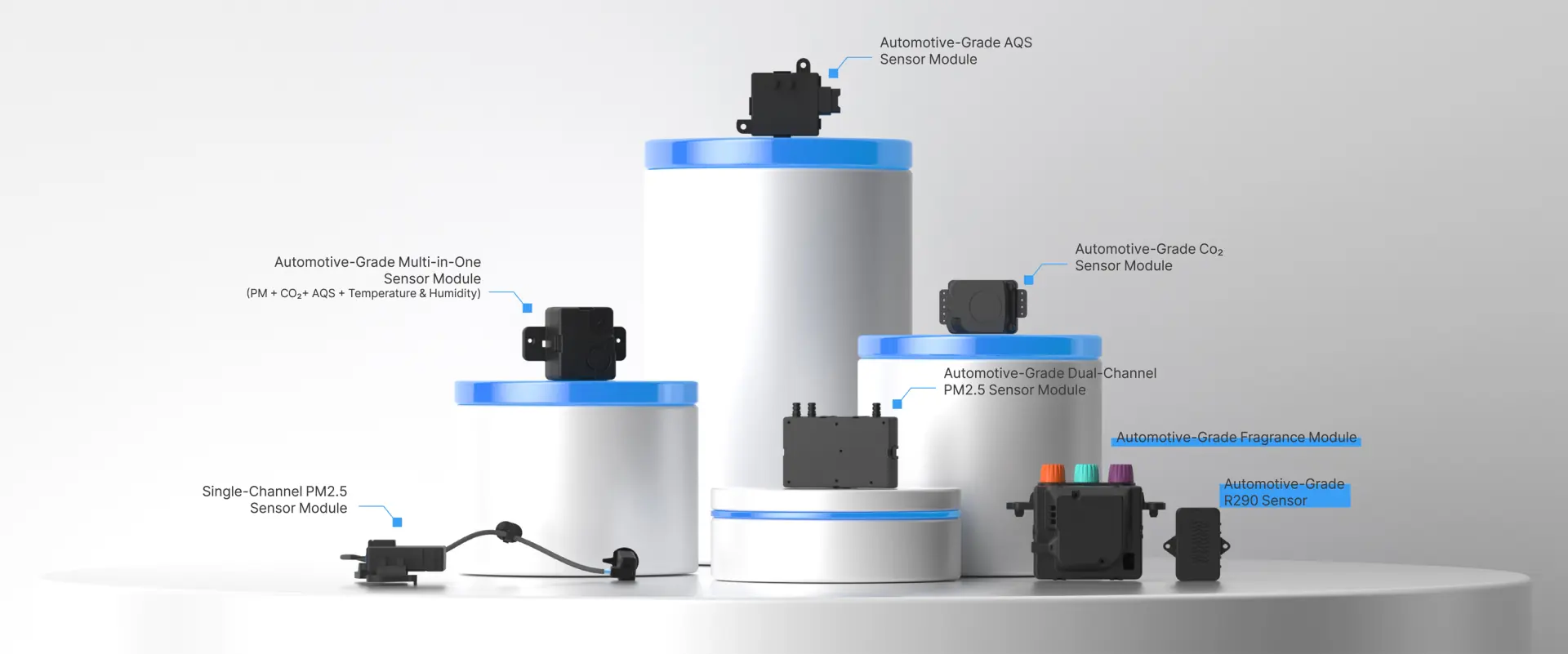
For smart-cockpit and HVAC upgrades in new energy vehicles, MAXMAC provides automotive air sensing and air-improvement solutions covering PM2.5, CO₂, AQS, all-in-one air-quality sensors, negative-ion modules, plasma modules, fragrance modules and in-vehicle air purification products.
In OEM healthy-cabin solutions, MAXMAC air sensors provide core inputs for HVAC recirculation and fresh-air control, air-quality display, filter-life estimation and scenario modes. CO₂ sensors support family road trips, lunch breaks, camping and long parking scenarios; AQS sensors help identify external exhaust, odours and pollutant gases; PM2.5 sensors support particle detection and purification strategies inside and outside the vehicle.
For fragrance systems, MAXMAC fragrance modules support controllable release, multi-scent switching, replaceable-cartridge architecture and smart-cockpit linkage, helping OEMs upgrade fragrance from a standalone comfort feature to an actuator for cockpit scenarios.
Conclusion
The 2026 Beijing Auto Show shows that cabin air systems are entering the smart cockpit's core functional area. PM2.5, AQS, CO₂, temperature and humidity sensors provide air-quality inputs; HVAC, fresh air, purification, negative-ion, plasma and fragrance modules execute the response; and the AI cockpit coordinates the system, turning air management into a user-visible experience through scenario modes, voice assistants and HMI.
In the next few years, competition will shift from feature availability to system capability. OEMs will continue to improve multi-sensor fusion, CO₂ strategies, fresh-air algorithms, fragrance linkage and air visualisation. Healthy cabins, smart HVAC and mood-based scenarios are converging, and the air system will become a foundational module of the smart cockpit.