Part 1 discussed frequent cabin-air risks, and Part 2 focused on mothers, infants and pets. Part 3 looks at a more everyday shift: people are spending more time inside parked vehicles. Weekend camping, outdoor breaks, in-car rest, passenger waiting and temporary work all turn the cabin into a short-stay living space. The value of that space does not come only from screens, audio and seats. It also comes from air care that users cannot directly see.
After LLM upgrades, cockpit intelligence becomes more valuable when natural language can be mapped to vehicle actions. When a user says, “I want to sleep for a while,” “keep the cabin comfortable at the campsite,” or “wake me up in 30 minutes,” the system has to confirm parking status, check occupancy, read PM2.5, CO₂, AQS/VOC, temperature, humidity and outdoor air data, then coordinate recirculation, fresh-air intake, purification, fragrance, seats, lighting and reminders. The LLM understands intent and explains status; sensors provide facts; HVAC and air-treatment hardware execute the service.

Automakers Are Turning Parked Stays into Scenario Entry Points
Publicly available product materials already point to a clear path for parked comfort. Tesla's owner manual describes Camp Mode as a way to maintain cabin temperature while keeping USB and low-voltage power available; Dog Mode emphasizes app-based temperature monitoring and alerts when climate control cannot be maintained. This shows that parked modes first solve a basic question: can climate and power remain stable when a person or pet stays in the vehicle?[1]
Chinese automakers are also making the cockpit programmable. XPeng's Smart Scenario Cockpit opens more than 350 vehicle-side capabilities for triggers and combinations. Li Auto's community article frames Camping Mode in everyday use terms: keeping cabin temperature comfortable, maintaining airflow and supporting longer stays, with lunch breaks mentioned as a common use case. Huawei's Xiaoyi materials highlight multimodal input, cross-device service flow and smart mobility scenarios, showing that assistants are moving from Q&A toward continuous services.[2][3][4]


These modes provide a useful baseline: OEMs have validated demand for parked stays. Many current functions still focus on temperature, power, seats, displays and convenience. An AI-enabled Healthy Cabin can bring air quality into the same scenario orchestration, moving parked comfort toward health-oriented maintenance. The LLM does not replace sensors or infer air quality by feel. It organizes sensor data, user habits, vehicle state and hardware actions into a loop that users can understand and the vehicle can execute.
Camping Mode: Long Outdoor Stays Need a Long-Horizon Air Strategy
The rise of camping and outdoor leisure makes the vehicle part of the campsite. Users pitch tents, cook, rest and power devices around the car, and may sleep in the vehicle at night. Air around campsites is not always stable: valleys can be humid, lakeside temperatures can swing, and barbecue smoke, campfire smoke, dust, pollen and nearby exhaust may appear. Users ask for comfort; the system has to express that comfort through temperature, humidity, particles, CO₂, odor and noise control.
In a camping scenario, the vehicle should first confirm parked safety: gear state, doors, windows, battery level, outside temperature, occupancy and external power load. The air system then scans the environment: whether PM2.5 rose after loading gear, whether CO₂ is accumulating with multiple occupants, whether AQS/VOC detects smoke or combustion odor, and whether humidity is approaching fogging or stuffiness. When outdoor air is clean, fresh-air ratio can increase. When smoke or particles rise outside, the system shifts to recirculated filtration and low-airflow purification.
The challenge is duration. Continuous climate control consumes energy, high purification levels add noise, and frequent recirculation changes can disturb temperature and humidity. A better strategy is staged: rapid ventilation and deodorization before settling in, low-noise maintenance during rest, slow fresh-air replenishment based on CO₂ at night, and a short fresh-air cycle in the morning. The LLM explains these choices clearly, such as: “Outdoor particles are high, so recirculated purification is on; cabin CO₂ is approaching the threshold, and low airflow fresh air will start in five minutes.”
For OEMs, Camping Mode can also personalize the experience. The vehicle can remember sleep temperature, fragrance intensity, airflow limits and screen brightness. Some users want silence, while others prefer slight airflow. Some are sensitive to scent, while others want a faint woody or herbal note. An AI-enabled Healthy Cabin makes these preferences data-based and responsive to outdoor air and cabin state.
In-Car Rest Mode: Short Breaks with Healthier Air in Underground Garages
Another frequent use case is common in urban work life. Many office workers prefer not to nap at their desks because they may be disturbed or feel watched, so they return to the car for 20 to 30 minutes. The cabin provides privacy, adjustable seats, controllable temperature and an alarm. The problem is that the vehicle is often parked in an underground garage, where air quality can be much worse than in open outdoor spaces.
Underground garages are enclosed or semi-enclosed microenvironments. Low-speed driving and idling can emit CO, NO₂, particles and VOCs. Studies note that vehicle emissions accumulate more easily where dispersion is limited, and research on hospital underground car parks points to particulate pollution risks in enclosed parking spaces.[5][6] For a sleeping user, the risk is not only “bad air”; active perception decreases during sleep.
In-Car Rest Mode needs finer logic than ordinary parked climate control. When the user says “I want to sleep for 30 minutes,” the car first checks external AQS, PM2.5 inside and outside, cabin CO₂, sleeping temperature and battery coverage. If garage air is poor, the system should not simply open fresh-air intake. It can keep recirculated purification, introduce small amounts of fresh air according to CO₂ growth, and raise filtration intensity during intake. If CO₂ rises too fast, the vehicle should suggest moving to a better-ventilated location.
The core experience is low disturbance. Strong direct airflow interrupts sleep, compressor cycling creates noise and temperature swings, and strong fragrance can feel uncomfortable in a closed cabin. In-Car Rest Mode should use a gentle curve: adjust temperature before sleep, reduce airflow after sleep begins, avoid blowing toward the face, keep purification quiet, and keep fragrance off or extremely light. Before the alarm, the system can slowly increase fresh air, brighten ambient light or restore the seat angle.
The mobile app also belongs in this loop. After parking in an office park, mall or campus, the app can suggest a nap-air mode based on location and air readings. After the rest ends, it can show a short record: duration, temperature range, peak CO₂, purification time and battery use. The point is not a complex report. The point is that users know the vehicle really maintained the environment.
The Air-Control Loop of an LLM Cockpit: Perception, Judgement, Action and Feedback
Intelligent-cockpit evaluation in the large-model era is moving from voice recognition toward perception, cognition, action, feedback and evolution. Research also treats these as important dimensions for evaluating cockpit LLM experiences.[7] In an AI-enabled Healthy Cabin, these dimensions form a clear architecture.
The perception layer includes PM2.5, CO₂, AQS/VOC, temperature, humidity, life detection, seat occupancy, window state and external air information. The cognition layer lets the LLM understand intent, scenario name, duration, preferences and risk level. The action layer calls HVAC, fresh-air intake, recirculation, filters, plasma or negative-ion modules, fragrance, seats, lighting and phone notifications. The feedback layer explains reasons, status and exceptions. The evolution layer learns sleep temperature, camping airflow, fragrance sensitivity and reminder frequency.
The boundary is critical. An LLM can understand “I feel stuffy,” “the cabin smells,” or “help me take a nap,” but air safety must be judged by sensors and vehicle state. The system can offer comfort maintenance while retaining safety prompts: exit when battery is low, remind the user when climate capacity is abnormal, suggest relocation when garage air remains poor, never leave children unattended, and require owners to monitor pets continuously. The premium feeling comes from active service and disciplined safety boundaries.

MAXMAC Value: Turning Air Hardware into Programmable Capability
For OEMs, Camping Mode and In-Car Rest Mode are not only about whether a button exists. Competitiveness depends on the hardware granularity behind it. PM2.5 sensors decide whether particulate changes are detected in time. CO₂ sensors reveal the source of stuffiness during long stays. AQS/VOC identifies exhaust, smoke and odor. Temperature and humidity support comfort curves and defogging. Purification, deodorization, plasma, negative ions and fragrance modules determine whether action can actually improve the air.
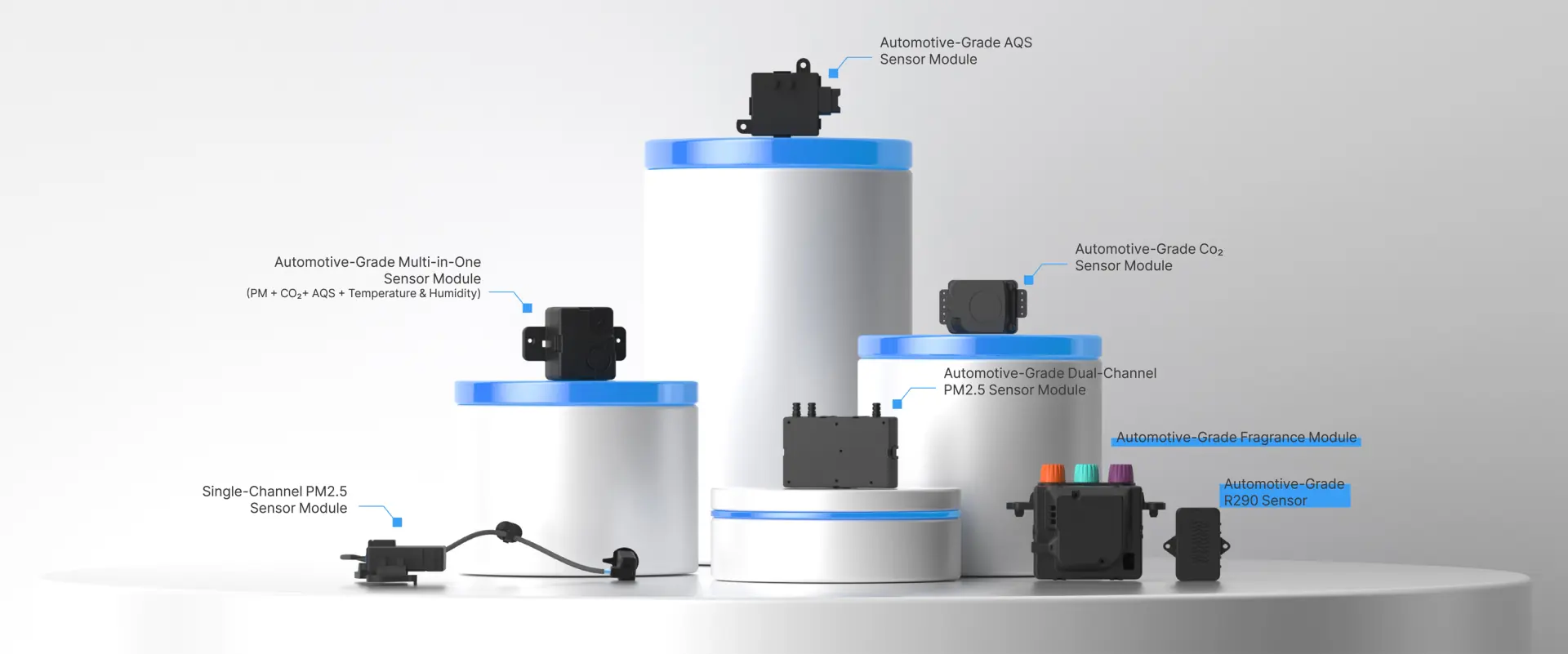
MAXMAC automotive air-quality sensors, AQS, CO₂, PM2.5, fragrance and air-treatment modules can be integrated into cockpit scenario orchestration. Sensors turn invisible air into data; execution modules turn data into perceptible change; the LLM explains that change as a service users can understand. Camping and in-car rest are only starting points. The same capability can extend to family travel, pet care, long waits, ride-hailing rest and business reception.
Conclusion
As OEMs upgrade LLM cockpit models, the higher-value direction is to help the cabin care for every minute people spend inside a parked vehicle. A parked-state healthy-air loop can move the intelligent cockpit from “able to chat” toward “able to care.” This is the next opportunity for the AI-enabled Healthy Cabin.
Sources
- Tesla Model Y Owner's Manual: Keep Climate On, Dog, and Camp. Referenced for parked climate, power and remote monitoring logic.
- XPeng: Smart Scenario Cockpit with editable capability. Referenced for editable scenarios and vehicle-capability orchestration.
- Li Auto Community: Camping Mode, beyond camping. Referenced for parked stays, lunch breaks and long-duration comfort.
- Huawei: Xiaoyi and full-scenario intelligence. Referenced for multimodal input and cross-device service flow.
- ScienceDirect: On-site assessments in naturally ventilated underground parking garages. Used for PM2.5, CO₂ and TVOC changes in parking garages.
- MDPI: Particulate Matter Characterization in a Hospital's Underground Car Park. Used for particulate characteristics and air-quality risks.
- arXiv: Development and Evaluation Study of Intelligent Cockpit in the Age of Large Models. Used for perception, cognition, action, feedback and evolution dimensions.