As smart cockpits enter the LLM era, users first notice smarter voice interaction and richer scenario cards. The real value of an AI-enabled Healthy Cabin has to land on specific people. Pregnant women, infants and pets do not open air-purification menus or watch PM2.5, CO₂, VOC and humidity values throughout a trip. The vehicle has to recognize who is inside, judge whether the current environment is suitable, and complete reminders, adjustment and feedback in a gentle way.
Special occupant care requires finer logic than ordinary air purification. A regular user may open a window, adjust airflow or switch recirculation after sensing odor or stuffiness. Pregnant women may be more sensitive to odor, heat, stale air and sudden air changes because of smell sensitivity, nausea, thermal-load changes and fatigue. Infants breathe more frequently, inhale more air per unit body weight, and still have developing detoxification and immune systems. EPA notes that children are not “little adults” because their development, behavior and exposure patterns differ from adults. WHO also links air pollution with respiratory risks in children and adverse pregnancy outcomes.[1][2]
Pet scenarios add another layer of complexity. Pets cannot clearly report heat, anxiety or discomfort, and they cannot open a window. After a pet leaves the vehicle, hair, dander, saliva, urine traces and odor molecules may remain in seats, carpets, floor mats and trim gaps. The air system therefore needs to cover two moments: while the pet is still in the cabin, the vehicle maintains temperature, humidity and air quality and synchronizes status to the owner; after the pet leaves, the vehicle recognizes that the trip included a pet and starts a residue-treatment process.


Sources: EPA, Children Are Not Little Adults; ACOG, Exposure to Toxic Environmental Agents - Air Pollution. These references support the need for more cautious cabin-air management for children and pregnant users.
Special Occupant Care: Identify Who Is in the Cabin Before Controlling the Environment
The second stage of the AI-enabled Healthy Cabin depends on one core question: who is the air strategy serving right now? A maternal-and-infant scenario needs stable temperature, low-irritation odor management, cautious fresh-air intake and moderate purification. A Pet Guard Mode scenario needs continuous monitoring, remote synchronization and escalation when abnormal conditions appear. A post-trip pet cleanup scenario treats remaining odor and allergens as issues to solve before the next ride.
This logic can be divided into five actions: cabin recognition, air-environment detection, threshold judgement, HVAC and purification execution, and status feedback. Recognition can come from seat occupancy, in-cabin cameras, child-seat status, pet-mode activation, app confirmation or voice command. The detection layer uses PM2.5, CO₂, AQS/VOC, temperature and humidity sensors. The execution layer coordinates HVAC, fresh air, recirculation, purification, deodorization, fragrance and seat-comfort settings. Cockpit AI explains what is happening, while the mobile app carries information when the owner is away from the vehicle.
Maternal and Infant Mode: Making Gentle Air a Baseline Family-Vehicle Capability
Maternal and infant mode serves two groups: pregnant women and babies. During pregnancy, changes in blood volume, cardiopulmonary load, thermal regulation and smell sensitivity can amplify discomfort from odor, stuffiness and unstable airflow. Clinical guidance continues to pay attention to the relationship between prenatal environmental exposure and outcomes such as low birth weight and preterm birth. ACOG encourages clinicians to consider environmental exposure during pregnancy, while WHO treats fine particles and other air pollutants as major public-health risks.[3][2]
Infant sensitivity is more direct. Babies breathe faster, have smaller airways, and their immune and metabolic systems are still developing. At the same pollutant concentration, the relative exposure from particles, ozone, VOCs or allergens can be higher for infants. In a compact, closed cabin with complex materials, VOC release after sun exposure, CO₂ accumulation during recirculation, exhaust ingress and excessive fragrance may all create discomfort.[1]
The first step is scene confirmation. The user may say “turn on maternal and infant mode,” or the system may infer the scene from a child seat, rear-seat occupancy, camera recognition and historical preference. Once confirmed, the air strategy becomes more conservative: temperature changes are softened, airflow avoids direct blowing toward the infant seat, outside-air intake references AQS and PM2.5 first, fragrance is disabled or kept at a very low level, and deodorization relies on filtration, ventilation and purification modules.
When in-cabin CO₂ continues to rise, the system should avoid sudden high airflow. A softer strategy checks outdoor PM2.5 and AQS first, then increases fresh-air ratio. If outside air is poor, the system can introduce filtered fresh air briefly and return to recirculation purification. If VOC or odor rises, the cockpit can say: “Cabin odor is slightly elevated. Fragrance has been turned off and gentle purification has started.” The value lies in explaining action clearly.
Pet Stay-in-Car Monitoring: Keeping the Owner Connected After Leaving the Vehicle
Pet Guard Mode care is a sensitive scenario. AVMA warns that pets should not be left alone in parked vehicles because cabin temperature can rise quickly and create heat-stress risk. In real use, owners may leave briefly while the EV still has power and HVAC capability. The vehicle needs to watch over the pet continuously and communicate status transparently.[4]

Reliable recognition is the starting point. The system can combine in-cabin cameras, seat pressure, a pet safety belt, rear-seat activity, app confirmation and voice commands. Once a pet is recognized, the vehicle enters an environment-maintenance strategy. Temperature and humidity become the highest priority, CO₂ indicates ventilation condition, and PM2.5/AQS decide whether outside air should be filtered before intake. HMI can show “Pet care active,” while the mobile app becomes the main interaction channel.
The mobile card should make the owner comfortable at a glance: cabin temperature, humidity, PM2.5, CO₂, battery or available support time, and pet image or posture status. Short phrases work best: “Environment normal, climate control active,” “Cabin temperature is rising, cooling has been increased,” or “Pet activity is low, please check the cabin view.” If HVAC capacity, battery level or temperature control becomes insufficient, the reminder should escalate and ask the owner to return immediately.
Pet emotion also matters. The vehicle should avoid sudden strong airflow, keep screen brightness and ambient light restrained, and use quiet climate control. When appropriate, a calming audio clip preset by the owner can be played. Cockpit AI coordinates air, sound and visual state so the pet remains in a stable environment and the owner receives clear feedback.
Post-Trip Pet Purification: Clearing Odor and Allergens Before the Next Ride
After a pet leaves, the cabin task is not over. CDC notes that pets may carry microorganisms that affect human health and that hygiene is important after contact. Mayo Clinic explains that pet allergens may come from dander, saliva and urine and can adhere to fabrics, carpets and upholstered surfaces. In vehicles, fabric seats, carpets, mats, headliners, soft door trim and foam materials can retain odor molecules, dander and hair. Leather or synthetic leather is easier to wipe, while seams, perforations, mats and cargo-area fabrics still create residue zones.[5][6]

The smart cockpit can mark “pet was in this trip” as a scenario tag. The tag may come from camera recognition, manual pet-mode activation, rear-seat pet activity or the app trip record. After the pet leaves, the vehicle does not need to wait until the next passenger notices odor. It can start a short scan after locking: PM2.5 tracks fine particles and hair-related changes, AQS/VOC detects odor and volatile pollutants, temperature and humidity help judge odor release and purification efficiency, and occupant detection confirms that no living being remains inside.
Execution should separate deodorization from masking. Covering pet odor with fragrance may create a mixed odor on the next ride. A better sequence is ventilation, filtration, then deodorization. If outside air is good, the vehicle uses outside-air exchange to reduce odor concentration. If outside air is poor, it keeps recirculation and increases filtration and purification. Deodorization, ion or plasma modules can intervene only after the cabin is confirmed empty. Fragrance is suitable only at the final stage at low intensity.
The mobile result can stay simple: “Pet trip completed. Cabin purification is complete and air status is normal.” If odor remains high, the system can suggest continuing purification for another few minutes or cleaning a rear mat or pet cushion. This turns invisible air recovery into a confirmable service and prepares the cabin for the next family member.
MAXMAC Solution Value: Sensing and Execution Foundations for Special Occupant Care
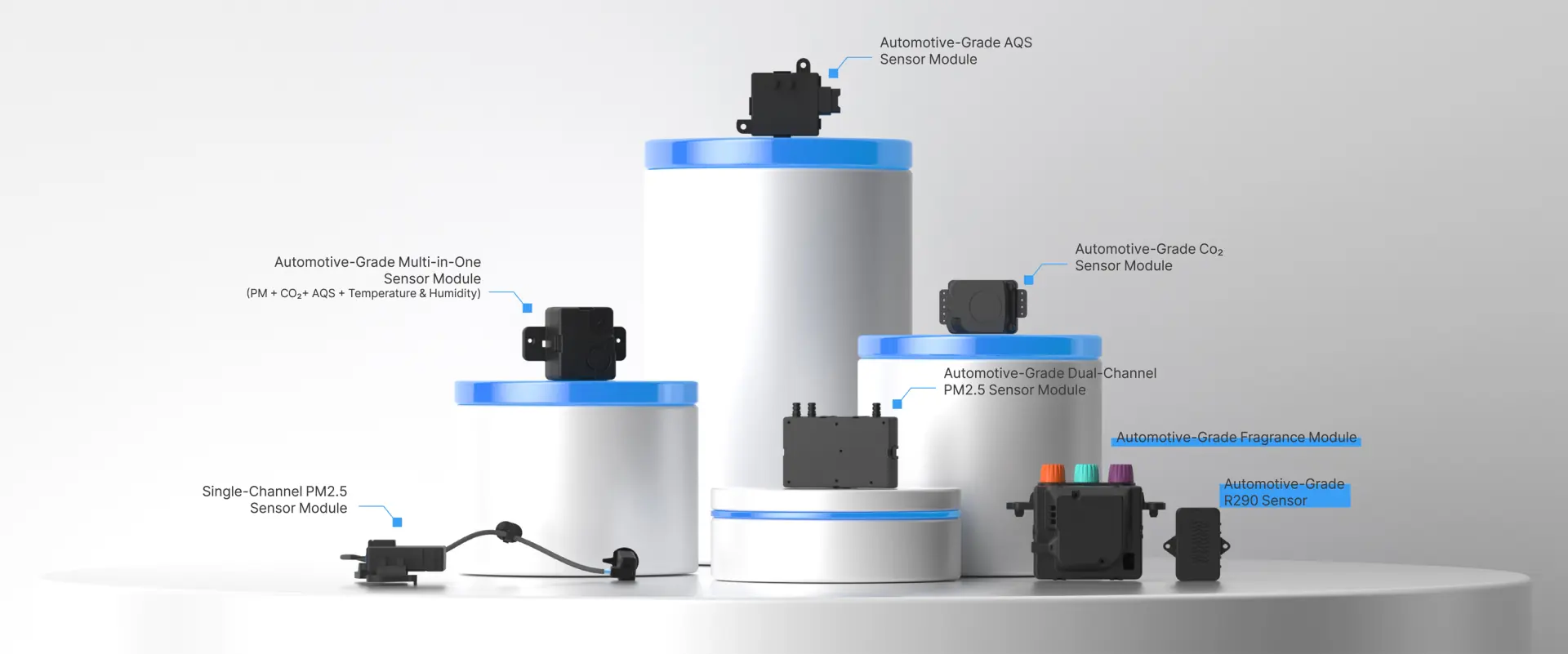
Maternal, infant and pet scenarios raise the bar for air-system design. The system has to recognize subtle changes, avoid over-intervention and explain execution results clearly. MAXMAC automotive air sensing and air-improvement solutions cover PM2.5, CO₂, AQS/VOC, temperature and humidity, multi-in-one air-quality sensors, negative ions, plasma, deodorization, fragrance and purification modules, providing hardware support for maternal-and-infant mode, Pet Guard Mode care and post-trip pet cleanup.
In maternal and infant mode, CO₂, humidity and VOC/AQS signals help the vehicle maintain gentler ventilation and purification. In Pet Guard Mode mode, humidity, CO₂ and PM2.5 data support mobile status reports so the owner knows the pet environment is controlled. In post-trip pet cleanup, PM2.5, AQS/VOC and deodorization modules help identify and treat hair, odor and residue before the next ride.
Conclusion
The second stage of the AI-enabled Healthy Cabin moves from handling air risks to caring for specific people and animals. Maternal and infant scenarios emphasize gentle, stable and low-irritation air management. Pet Guard Mode scenarios emphasize continuous care and remote reassurance. Post-trip pet cleanup focuses on residue treatment and the next ride experience. Special occupant care turns the air system from a general comfort feature into a family-scenario service, giving cockpit AI a more tangible sense of care.
Sources
- https://www.epa.gov/children/children-are-not-little-adults. U.S. EPA, Children Are Not Little Adults. Used to explain why children’s exposure patterns and physiology differ from adults.
- https://www.who.int/news-room/fact-sheets/detail/ambient-(outdoor)-air-quality-and-health. WHO, Ambient (outdoor) air pollution and health. Used to describe PM2.5 and air-pollution risks for public health, children and pregnancy.
- https://www.acog.org/clinical/clinical-guidance/committee-opinion/articles/2013/10/exposure-to-toxic-environmental-agents. ACOG, Exposure to Toxic Environmental Agents. Used to support pregnancy-related attention to environmental and air-pollution exposure.
- https://www.avma.org/resources-tools/pet-owners/petcare/pets-vehicles. AVMA, Pets in Vehicles. Used to explain the risk of leaving pets in vehicles and heat stress.
- https://www.cdc.gov/healthy-pets/about/index.html. CDC, About Healthy Pets, Healthy People. Used to explain hygiene and health considerations after pet contact.
- https://www.mayoclinic.org/diseases-conditions/pet-allergy/symptoms-causes/syc-20352192. Mayo Clinic, Pet allergy - Symptoms and causes. Used to explain pet dander, saliva and urine as allergen sources and their attachment to soft surfaces.