Over the past two years, automakers have been integrating LLMs into smart cockpit platforms at scale. As voice assistants and cockpit AI become more capable, the in-cabin interaction has moved into a new phase. Consumers understand that LLMs are powerful, but many everyday scenarios still need to be designed before that capability becomes useful. Like a smartphone with many features, the vehicle needs scenario design to release the value users can actually feel.
The AI-enabled healthy cabin is a natural high-frequency entry point for AI cockpits. Air purification, fresh air, recirculation, fragrance and deodorization used to sit deep inside climate menus. With language understanding and proactive orchestration, the vehicle can start service based on air quality, road context and occupant state. It can add fresh air when CO₂ rises, switch to recirculation before entering a tunnel, or explain why purification starts when dust or smoke is detected.
1. Overall Concept: The Closed Loop of an AI-enabled Healthy Cabin
The foundation is air-quality sensing. PM2.5 sensors identify particles, smoke, pollen and road dust; CO₂ sensors judge ventilation in a closed cabin; AQS or VOC sensors detect exhaust, odor and volatile pollutants; temperature and humidity support thermal comfort and defogging. When these signals enter the HVAC controller and cockpit domain, air-quality change becomes scenario judgement.
The chain can be summarized as detection, threshold judgement, AI proactive reminder, HVAC actuation, purification and air treatment execution, and status feedback. For OEMs, the difficulty has shifted from stacking hardware to ensuring consistency among sensing accuracy, strategy, actuator response and HMI expression.

2. Four High-Frequency Scenarios: From Risk Detection to Active Air Purification
Part 1 focuses on fatigue driving, tunnel pollution, road dust and in-cabin smoking. These scenarios have clear triggers, strong user perception and practical value for production vehicles and sales demonstrations.
1. Fatigue driving: bringing CO₂ and air comfort into active safety
Long-distance, night-time and congested driving all increase fatigue risk. In a closed cabin, CO₂ accumulates over time and may contribute to drowsiness, reduced attention and discomfort. Outdoor-level CO₂ is typically around 400 ppm. When the in-cabin value continues above about 800-900 ppm, the system can treat it as a ventilation warning and send the data to the cockpit or HVAC controller.
After receiving the high-CO₂ signal, the AI cockpit combines driving duration, road state and speed. It can first issue a light voice or HMI reminder and start fresh-air supplementation. If pollution outside is high, it balances short fresh-air intake, filtration, purification and recirculation.
If the risk continues, the system can call the in-cabin camera to identify driver yawning, eye closure, head nodding or attention decline. The reminder can then escalate from ventilation advice to a rest suggestion. The vehicle first ventilates and purifies, then uses navigation to recommend the nearest service area.
2. Tunnel pollution: external pollution detection and preventive recirculation
Tunnels and enclosed roads accumulate exhaust, odors and particles. AQS identifies exhaust, NOx, VOCs and odors, while PM2.5 sensors capture particle changes. Map or navigation data can help the AI cockpit prepare before entry.
Before the vehicle enters a tunnel, the cockpit can give a brief reminder and switch HVAC to recirculation. During the tunnel section, AQS and PM2.5 continue monitoring. After exit, the system restores outside-air intake only when outside air is suitable.
3. Road dust: air protection for high-dust road conditions
Construction roads, earth-moving vehicles and unpaved sections create sudden particle peaks. This scenario tests sensor response and short-peak control strategies.
When external particles rise quickly, the vehicle can reduce outside-air intake, increase filtration airflow and start purification modules. After passing the polluted area, it can gradually supplement fresh air to avoid CO₂ accumulation.
4. In-cabin smoking: rapid pollution treatment and odor recovery
Smoking introduces particles, VOCs and persistent odor. PM2.5 sensors capture smoke particles, AQS/VOC detects odor change, and CO₂ helps judge ventilation.
After identifying smoke or odor, the AI cockpit can provide a polite prompt, increase airflow, choose outside-air exchange or recirculation purification based on external air quality, and coordinate deodorization, ion or plasma modules. Low-intensity fragrance can be introduced after the odor source is reduced.
3. AI Proactive Reminders: Turning Air Systems into Cabin Services
An AI-enabled healthy cabin should avoid pushing every parameter to the screen. Better interaction means that AI intervenes only when a threshold, scenario change or completion status matters. Fatigue reminders should be calm and short; tunnel and road-dust prompts should focus on what the vehicle has already handled; smoking scenarios should present air-quality abnormality and purification progress.

Explanation builds trust. When users hear that outside air is poor and recirculation purification has started, they understand why airflow changed. When CO₂ is high and fresh air is being added, they understand why the vehicle briefly introduces outside air.
4. Production Focus: Sensors, Strategy and Actuators Must Work Together
All four scenarios depend on the same engineering logic: reliable sensor data, scenario recognition, HVAC and air treatment execution, and clear HMI/voice feedback. If PM2.5 rises but HVAC does not respond, or purification starts without explanation, the function feels disconnected.
5. MAXMAC Solution Value
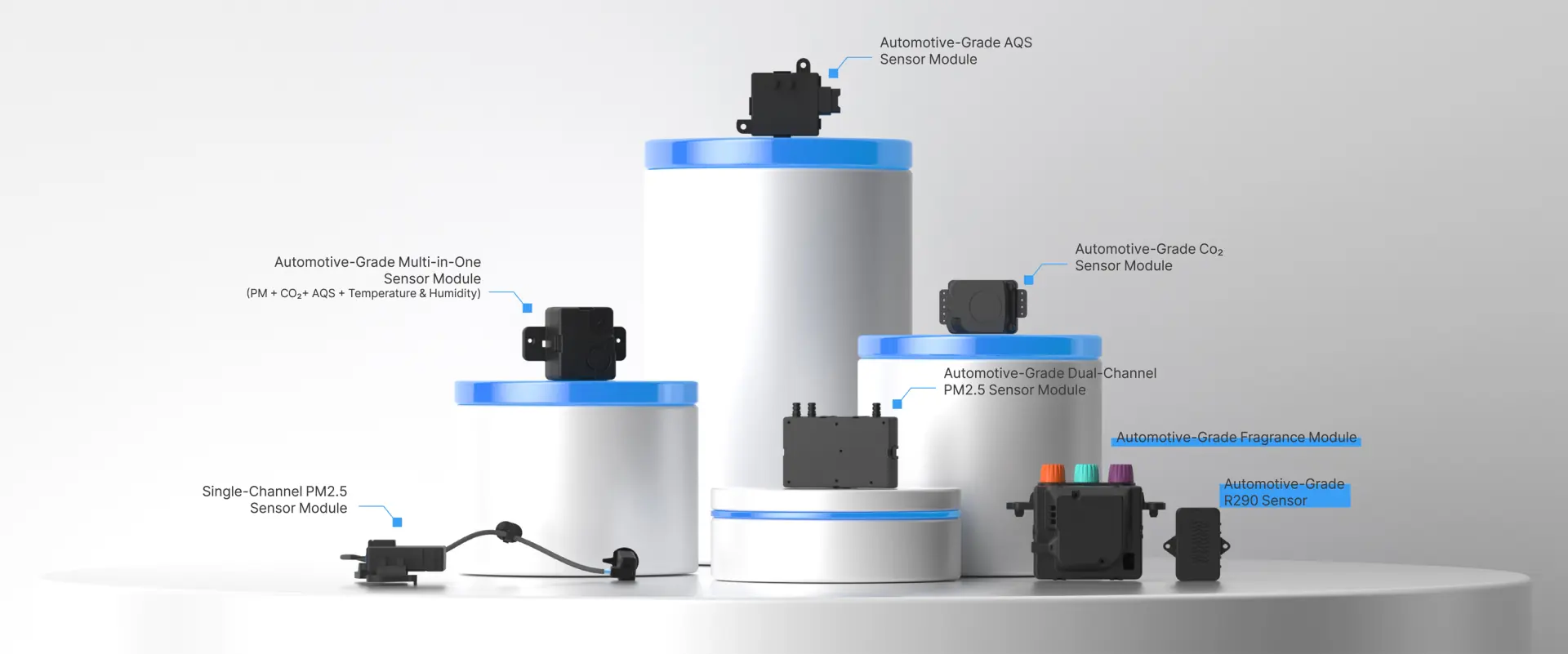
MAXMAC provides core hardware for OEM AI-enabled healthy cabin programs, including PM2.5 sensors, CO₂ sensors, AQS/VOC sensors, multi-in-one air-quality sensors, negative ion modules, plasma modules, deodorization modules and fragrance modules. These products provide inputs and execution support for recirculation, fresh-air control, purification strategy, air-quality display and AI scenario reminders.
Conclusion
The first stage of the AI-enabled healthy cabin can start with high-frequency air risks: stuffiness, exhaust, dust and odor. When detection, threshold alerts, HVAC actuation, purification and AI reminders form a complete loop, the system moves from configuration to service.
Future articles can continue with parking comfort and health, special-occupant protection, and people-vehicle-home ecosystem scenarios. As cockpit LLMs, vehicle HMI, and air hardware become more deeply integrated, air systems will derive more practical use cases and serve users with more diverse needs.