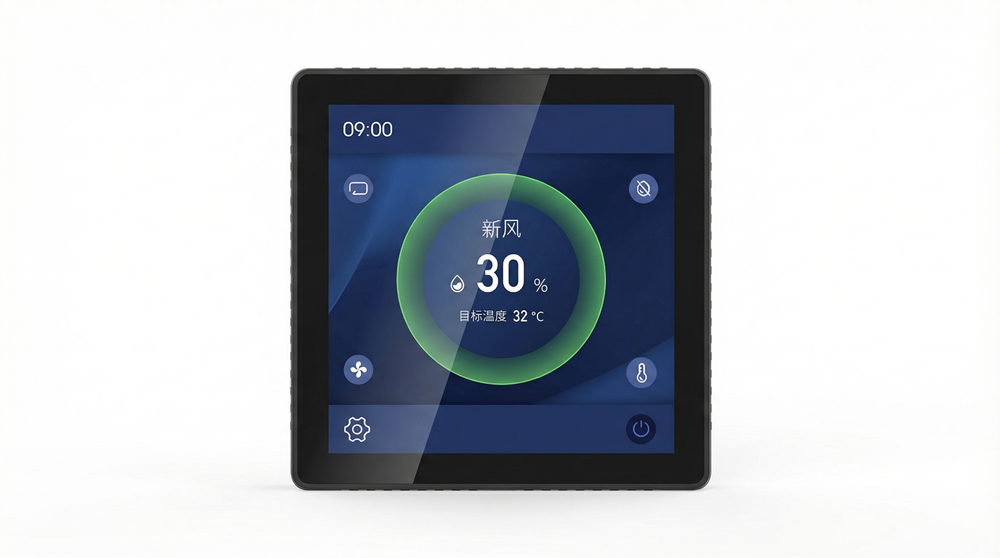
As HVAC and fresh air systems continue to evolve, user expectations for air quality monitoring have long moved beyond
simply viewing a number, and certainly beyond merely switching equipment on or off. A truly valuable system should be
able to answer three questions:
First, what is the actual air quality being breathed in this room right now?
Second, should the system adjust, by how much, and through which control path?
Third, after adjustment, has the air quality genuinely improved, rather than the equipment simply having responded?
These three questions make it clear that air quality monitoring cannot remain at the level of simply having a sensor. It must move toward a closed-loop logic based on room-level sensing, zone-based judgment, demand-based regulation, and outcome-based verification.
That is exactly why directly integrating air sensors into an 86 controller is not merely a change in installation form. It is a critical step from an equipment-centered approach toward a space-centered approach, and from broad linkage toward zone-level closed-loop control.
In the industry, CO₂ sensors may be installed inside rooms on walls, or placed in return air ducts or ventilation ducts. The U.S. Green Building Council’s LEED reference guidance clearly requires CO₂ sensors to be located in the breathing zone, and notes that CO₂ sensors installed in return air ducts do not meet this requirement. Trane’s technical documentation for multi-zone VAV systems also states that a single return duct CO₂ sensor measures only an average concentration, which can result in under-ventilation in some spaces and over-ventilation in others. [External Reference 1] [External Reference 2]

Further research in building environments also shows that sensor placement significantly affects how well CO₂ measurements represent occupant exposure. Concentration distribution within a room is not necessarily uniform, which means the monitoring location itself influences both control outcomes and judgment accuracy. [External Reference 3] [External Reference 4]
1. Why Traditional Duct-Based Monitoring Struggles to Deliver True Room-Level Air Quality Identification
Many conventional solutions install air quality sensors in return air ducts, ventilation ducts, inside air handling units, or rely on a sensor in a common area as the control basis for the entire system. This approach has engineering advantages, including simpler wiring, lower cost, and easier centralized control. Trane’s technical documentation also notes that in multi-zone systems, placing one CO₂ sensor in every room significantly increases cost, which is why return-air or system-level point substitution is often adopted in practice. [External Reference 5]

The challenge, however, is that HVAC systems control airflow, while users care about room experience. These are not always the same thing.
When a sensor is installed on the return air side, what it often measures is the mixed average of multiple rooms. Trane explicitly states that a single return duct sensor measures the average CO₂ concentration, which may cause insufficient ventilation in some spaces and excessive ventilation in others. This means that if someone remains in a child’s room for a long period with doors and windows closed and CO₂ rises rapidly, a system looking only at return air or common-area averages may fail to detect how quickly conditions are deteriorating in that specific room. [External Reference 6]

Vaisala’s article on wall-mounted HVAC sensor installation points out that even when sensor performance is strong, an improper installation location can still distort readings. When room sensors are installed correctly, HVAC systems can respond more accurately to actual indoor conditions while also improving comfort and reducing energy waste. [External Reference 7]
In other words, from the perspective of seeing the true air condition of each room, traditional duct-based monitoring is better suited to system-level trend judgment, but is not naturally optimized for refined room-level closed-loop control.
2. The Real Value of Integrating Air Sensors into an 86 Controller Goes Far Beyond Saving One Installation Position

An 86 controller is naturally positioned at the room control node. Every bedroom, living room, study, meeting room, hotel guest room, clinic room, or classroom already requires a local control interface. When an air sensor is directly integrated into the 86 controller, sensing capability is naturally distributed to each individual room, bringing several highly tangible advantages.
The greatest value of this integration method is not simply eliminating one separate sensor installation position. It is that the sensor naturally becomes part of the room itself. Since every room already requires a controller, every room also gains an air monitoring point as a natural extension. Installation becomes more intuitive, wall surfaces remain cleaner, and wiring and commissioning become more efficient.
More importantly, because the sensor is located directly inside the room, what it measures is the real-time air condition of that room rather than a result inferred indirectly from duct data, return-air averages, or other zones. This allows the system to truly observe changes in CO₂, temperature and humidity, VOCs, or other air parameters in each room, providing a more accurate data foundation for subsequent linked control.
3. Core Advantage One: Direct In-Room Sensing to Avoid Misjudgment Caused by Averaged Values

For many projects, the biggest misunderstanding is not the absence of air monitoring, but the fact that monitoring exists while the sensing point is not located in the room that actually needs attention. When the system relies on duct, return-air, or common-area data, what it sees is often the combined state of multiple spaces rather than the problem of a specific room.
Once the air sensor is built into the 86 controller, the system can directly identify which room’s CO₂ is continuously rising, which room has excessive humidity, which room is experiencing abnormal VOC fluctuations, and which room consistently remains in a comfort zone. In this way, the system no longer relies on whole-house averages to infer local problems. Instead, it directly identifies the actual air quality of a specific space.
For residential users, the value of this capability is highly intuitive. A child’s room, elderly room, master bedroom, and study all differ in importance and usage pattern. What users truly care about is not whether the overall system average looks acceptable, but whether the child’s sleeping room actually has good air, whether the elderly person’s room is comfortable, and whether the study has become stuffy during extended periods of work.
4. Core Advantage Two: One Controller per Room Naturally Supports Zone-Based Monitoring and Zone-Based Control

If traditional methods are used to achieve true multi-room air monitoring, it often becomes necessary to add multiple independent sensor points, involving installation location, power supply, communication, wall openings, interior coordination, and system mapping. Project complexity rises significantly. Once sensors are integrated into the 86 controller, all of this becomes naturally simplified.
Because every room already requires a controller, every room naturally acquires an air sensing node. This allows the system to build a highly intuitive “one room, one strategy” logic: one set of data per room, one linked control rule per room, and one status display per room.
This architecture is especially important for true zone-based control. It moves away from coarse whole-house adjustment and instead determines, according to the actual condition of each room, which space should be prioritized for ventilation, which should be prioritized for dehumidification, and which can remain in energy-saving standby. In this way, HVAC and fresh air systems are upgraded from average-based control to demand-based control.
5. Core Advantage Three: Truly Connecting HVAC and Fresh Air Logic to Form a Closed Loop

Many systems claim to have achieved air quality linkage, but in reality remain at the level of simple trigger logic: if CO₂ rises, increase fresh air slightly; if humidity rises, enable dehumidification; if VOCs fluctuate, turn on the fan. This is closer to a conditioned reaction than to a complete closed loop.
A true closed loop should include four steps: sensing, judgment, execution, and verification. In other words, the system first collects real-time air data through the in-room 86 controller; then makes decisions based on room type, time period, occupancy status, threshold strategy, and rate of change; then drives HVAC, fresh air, purification, fan coil units, valves, or airflow regulation to act; and finally continues to monitor the room’s data to verify whether the adjustment actually delivered the intended effect.
Only when the sensor is actually located inside the room can the system truly determine whether the recent increase in fresh air volume actually reduced CO₂ in the child’s room, whether activating dehumidification really brought the master bedroom back into the comfort range, or whether a recent energy-saving reduction still maintained acceptable air quality in the study. This is a true outcome-based closed loop, not merely a device-action loop.
6. Core Advantage Four: Reducing Unnecessary Automatic Adjustments and Lowering Energy Waste

Under traditional average-value control logic, systems often face two types of problems. In one case, air quality in a particular room has already deteriorated, but because the average has not changed significantly, the system reacts too late. In the other case, a short-term fluctuation in a local zone triggers whole-house adjustment, causing excessive operation.
EPA guidance on air sensor siting recommends that indoor sensors be placed near typical breathing zone height and away from local pollution sources, air purifiers, corners, obstructing furniture, as well as doors, windows, and HVAC supply and return vents that may distort the data, in order to obtain more representative indoor air readings. Put simply, the closer the sensor location is to the real occupied space, the more reliable the control basis becomes. [External Reference 8]
Once air sensors are integrated into the 86 controller, the system can more precisely limit control actions to the rooms or zones where there is a real need, avoiding ineffective adjustments caused by rough judgment. It does not simply make the system more sensitive. It makes the system more targeted in its response, balancing both comfort and energy efficiency.
7. Typical Application Scenarios
Scenario 1: Children’s Rooms / Nursery Rooms. At night, children’s rooms are typically enclosed, relatively small, and occupied for extended periods, often with an adult staying in the room for caregiving, night feeding, or sleeping nearby. In such rooms, fluctuations in CO₂, temperature, and humidity are usually more pronounced than in daytime common areas. If the system relies only on the living room, return air vent, or common-area averages, it is easy to encounter a situation where the overall system appears normal while the child’s room is already stuffy. When the sensor is installed directly in the 86 controller within the child’s room, the system sees the room’s own air changes and can directly coordinate fresh air or air supply terminals to prioritize the air condition of that space.
Scenario 2: Bedrooms During Nighttime Sleep. Bedrooms are typical high-occupancy, highly enclosed, slow-changing spaces. During sleep, doors are closed, occupants continue breathing, and external disturbances are minimal, so CO₂ often accumulates gradually. An in-room sensor can continuously track this change curve. Once CO₂ or temperature and humidity reach the threshold, the system can increase fresh air or coordinate air conditioning operation on demand. Once conditions recover, it can return to a more energy-efficient operating mode.
Scenario 3: Study Rooms / Home Office Spaces. The defining characteristic of a study is not the number of people, but concentrated occupancy, closed doors, and high demand for sustained attention. When one person works, studies, or attends meetings in the room for long periods, CO₂ and comfort parameters can shift faster than expected. If the system still relies on living room or total return-air averages, its response will often be too slow. By integrating the sensor into the study’s controller, the system can truly make the room an independent air management unit when occupied, and avoid unnecessary operation when it is not in use.
Scenario 4: Hotel Guest Rooms / Apartment Units. Hotel guest rooms are especially well suited to 86 integrated air control solutions. Each room already requires a local control terminal, while occupancy status, occupant density, and window-opening habits vary from room to room. By integrating the air sensor into the controller, the system can establish independent logic around each guest room: low-energy standby when vacant; operation based on actual air conditions when occupied; automatic coordination of fresh air and air conditioning according to CO₂ and humidity changes at night; and restoration of basic ventilation and energy-saving mode after checkout.
Scenario 5: Offices / Meeting Rooms. Meeting rooms are typical high-volatility spaces: empty most of the time, then suddenly occupied by many people at once, with CO₂ rising rapidly. If the system looks only at return-air averages, it will usually react too slowly to changes in the meeting room. When the meeting room’s 86 controller includes an integrated air sensor, the system can quickly identify the air pressure on that specific zone and coordinate fresh air volume or fan coil operation accordingly, ensuring that the space with demand receives priority response.
8. From a Product and Delivery Perspective, the Practical Advantages of Integrating Air Sensors into an 86 Controller

From the perspective of product design and project execution, the 86 integrated solution delivers at least five direct advantages.
First, the installation position is naturally appropriate. The controller is already wall-mounted, already inside the room, and already close to the occupant activity zone, making it far more direct than placing a sensor into a duct and inferring room conditions from there.
Second, it saves sensing points, wiring, and commissioning effort. Once the controller and sensor are integrated, there is no need to identify a separate installation position for a sensor in each room. Project delivery becomes cleaner and the wall appearance remains more consistent.
Third, it is naturally suited to one-room-one-strategy control. Each room has one controller, one set of air data, and one linked strategy, which is far more scalable than retrofitting sensors later.
Fourth, it makes visualization and user awareness easier. Users can directly see the current air status, operating mode, and linked control status in the room itself, rather than having the system adjust quietly in the equipment room without users understanding why.
Fifth, it becomes easier to establish a true closed loop. Because sensing, control, display, and communication are all located at the same room-level node, the system can more easily integrate data collection, execution, and feedback into one unified process.
Conclusion
In the future, the competitive value of high-quality HVAC and fresh air systems will not lie simply in whether they include air sensors, but in whether the system can truly identify the air condition of specific rooms, connect HVAC and fresh air control logic, and build a genuine outcome-oriented closed loop.
Integrating air sensors directly into the 86 controller essentially moves air monitoring capability down to every room-level node within the system architecture, allowing the system to know not only what the air inside the duct is like, but what people in each room are actually breathing.
This improves the accuracy of air quality recognition, gives automatic regulation a stronger basis, makes energy use more efficient, and creates a more tangible room-level experience. For projects that aim to balance comfort, health, energy efficiency, and intelligent coordination, this is a more complete and more practical air quality monitoring solution.
External Reference Links
[External Reference 1] USGBC: CO₂ sensors must be located in the breathing zone; return air ducts do not meet the requirement.
https://www.usgbc.org/node/2752139
[External Reference 2] Trane: In multi-zone VAV systems, a single-point return duct CO₂ sensor measures an average value, which may lead to under-ventilation in some spaces and over-ventilation in others.
https://www.trane.com/content/dam/Trane/Commercial/global/learning-center/ashrae-articles/CO2-Based%20Demand-Controlled%20Ventilation%20with%20ASHRAE%20Standard%2062.1.pdf
[External Reference 3] Research material: Sensor placement affects CO₂ control performance.
https://escholarship.org/content/qt8n23p8c4/qt8n23p8c4.pdf
[External Reference 4] ScienceDirect: CO₂ sensors at different locations differ in how well they represent personal exposure and room occupancy.
https://www.sciencedirect.com/science/article/pii/S0378778823007697
[External Reference 5] Same Trane document: explains that point-by-point deployment across multiple rooms is more refined, but also more costly.
https://www.trane.com/content/dam/Trane/Commercial/global/learning-center/ashrae-articles/CO2-Based%20Demand-Controlled%20Ventilation%20with%20ASHRAE%20Standard%2062.1.pdf
[External Reference 6] Same Trane document: a single return-air average does not represent the true condition of each room.
https://www.trane.com/content/dam/Trane/Commercial/global/learning-center/ashrae-articles/CO2-Based%20Demand-Controlled%20Ventilation%20with%20ASHRAE%20Standard%2062.1.pdf
[External Reference 7] Vaisala: Proper wall-mounted sensor installation can improve HVAC response accuracy and reduce energy consumption.
https://www.vaisala.com/en/expert-article/how-install-wall-mounted-sensors-optimal-energy-efficiency-and-indoor-air-quality
[External Reference 8] EPA: Indoor sensors should be placed as close as possible to the breathing zone and away from doors, windows, HVAC vents, furniture obstructions, and local pollution sources.
https://www.epa.gov/air-sensor-toolbox/guide-siting-and-installing-air-sensors